Perspectives
From Documentation to Decision: AI’s Next Chapter in Clinical Care
Historically, healthcare has not been known for adopting technology quickly. Electronic health records (EHRs) took more than a decade to move from early adopters to near-universal use across U.S. hospitals and office-based physicians. Meanwhile, ambient AI scribes now run in roughly two-thirds of U.S. health systems, the most widely adopted AI application in the sector, with adoption in that category growing 62% in a single year. The contrast signals that when value is obvious and integration is simple, this industry can move at the pace of any other.
But that speed came with a boundary. Healthcare’s first AI wave was almost entirely a back-office story: ambient documentation, coding and billing, revenue cycle, and prior authorization. All of these offered clear integration paths and measurable ROI, and buyers (health system CFOs and revenue cycle leaders) were already comfortable purchasing software on efficiency alone. Winners emerged quickly and raised heavily, but the advantage is already eroding: Epic now ships ambient documentation natively, and Doximity gives its scribe away for free. All of this targets administrative spend – roughly $1.5 trillion of a $5.3 trillion U.S. health system, and a fixed pool that more companies compete over every quarter.
That boundary is now breaking down, and not evenly. Three-quarters of U.S. health systems run at least one AI solution, up from 59% a year earlier, and 84% of payers apply AI or machine learning in plan operations, but the most widely deployed applications remained clinical note-taking, documentation improvement, and coding. The administrative wave, in other words, is what most institutions have actually bought.
Consumers are under no such constraint. Thirty-two percent used an AI chatbot for health information in 2025, double the prior year’s rate, and they are asking clinical questions — treatment options for a diagnosis, what a set of symptoms might mean, whether a medication is right — not administrative ones. Notably, roughly three-quarters of those users went to general-purpose tools like ChatGPT, while only 5% used a provider-built chatbot and 4% a payer-built one. Demand for AI inside the care decision is already here. The supply side is what must catch up.
That is why the larger opportunity sits in the delivery and coordination of care itself. Hospital care accounted for $1.6 trillion in 2024, physician and clinical services for $1.1 trillion, and retail prescription drugs for $467 billion — together more than half of national health expenditure. We define clinical AI as software that participates in the care decision itself — detection, triage, diagnosis, and treatment pathways. That is the category we believe defines the next chapter – addressing the nearly $3.2 trillion spend outlined above. It is also a harder one: clinical AI faces evidentiary, regulatory, and reimbursement hurdles that ambient documentation never did.
The case for clinical AI starts with capacity challenges. The U.S. faces a projected shortfall of up to 86,000 physicians by 2036, driven by an aging population and an aging physician workforce. Rural counties have 44% fewer patient-facing health care workers per capita than urban ones, a gap that widens for the most highly trained clinicians, and the average wait for a new-patient specialist appointment across 15 major U.S. metros reached 31 days in 2025. Training more physicians will not close these gaps in time; instead, it will require technology that meaningfully extends what existing clinicians can do.
The Autonomy Curve
Not all clinical AI carries the same risk, and the market is not one market. We organize the category along an autonomy curve. Level 1: assistive tools surface information and the clinician decides the next best action. Level 2: semi-autonomous systems recommend a specific action a clinician approves or rejects. Level 3: supervised autonomy acts within pre-approved guardrails while a clinician monitors by exception. Level 4: full autonomy would initiate and adjust treatment independently with no real-time human review, and remains largely theoretical in clinical care today.
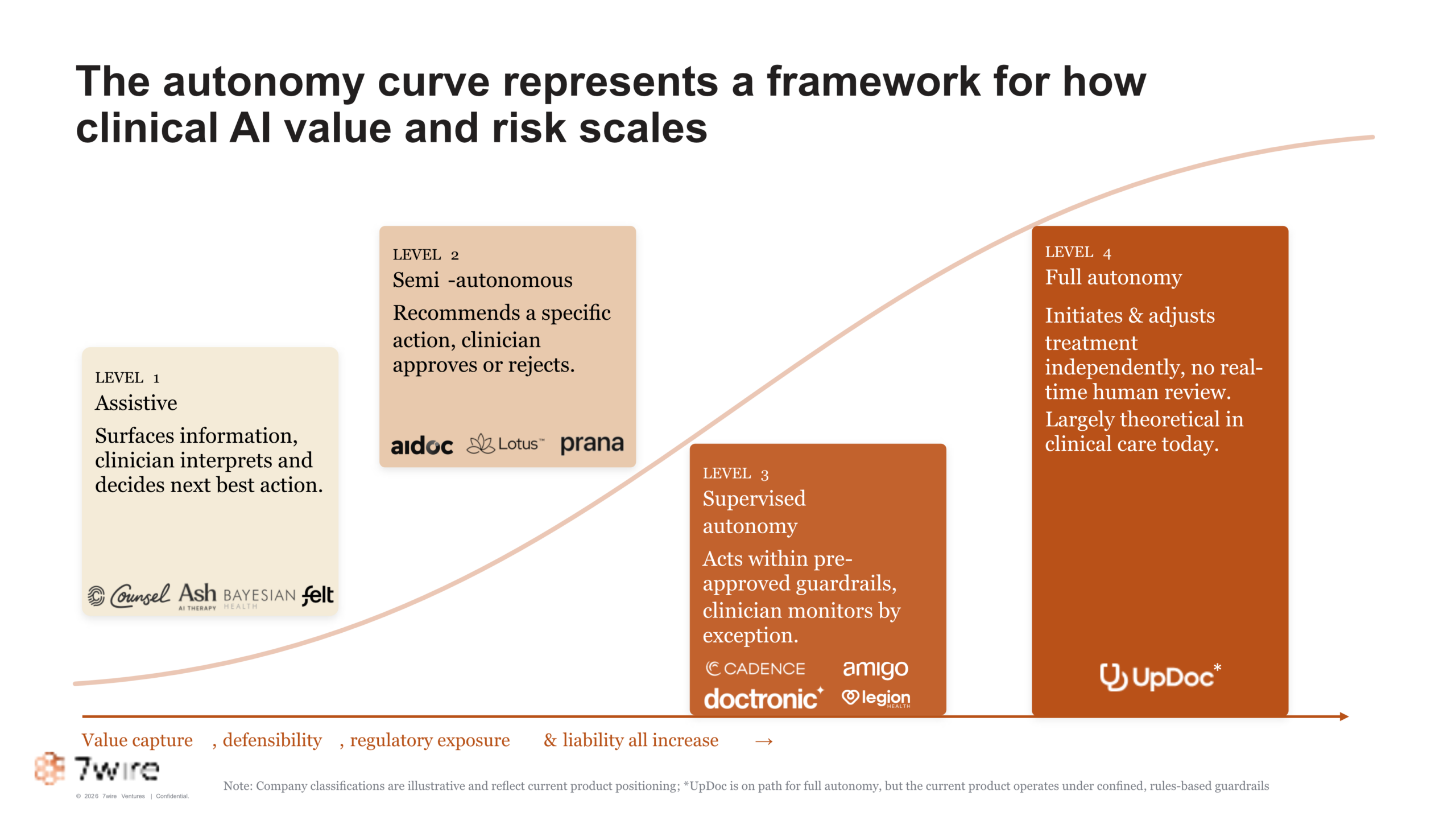
Value capture, defensibility, regulatory exposure, and liability all rise together as a product moves up that curve — which is why the most instructive regulatory event of the past year is also the most easily misread. In June 2025, the FDA announced the clearance of UpDoc as the first Software as a Medical Device built on patient-facing large language models. That does not mean UpDoc is cleared for autonomous clinical decision-making today. The indication is narrow and specific: insulin dose management for adults with type 2 diabetes, cleared through the standard 510(k) route by demonstrating substantial equivalence to a 2019 insulin-dosing calculator. The signal is real but limited: the FDA will clear higher-autonomy clinical AI through existing pathways, but only when the underlying clinical logic stays narrow and predictable.
Meanwhile, the companies that built the largest physician audiences are moving upstream toward the decision itself. Doximity acquired Pathway Medical for $63 million in July 2025, bringing a structured clinical evidence dataset to Doximity GPT. OpenEvidence deployed enterprise-wide at Cedars-Sinai in May 2026, embedding point-of-care search in their EHR and linking evidence to the individual patient record. Abridge expanded from ambient documentation into a clinical intelligence platform in June 2026. The competition is shifting from whose model performs best to who owns the physician relationship at the moment of decision — and as that channel consolidates, standalone point solutions will get bundled into broader platforms.
What Still Stands Between Capability and Adoption
We view five areas standing between today’s AI capability and real-world clinical adoption. The first is that strong benchmark performance does not guarantee smooth deployment. In a 2024 randomized trial published in JAMA Network Open, GPT-4 alone scored roughly 16 percentage points higher on diagnostic reasoning than physicians using conventional resources. However, giving those physicians access to GPT-4 did not significantly improve their own performance. The finding that matters for operators is the second one: workflow design, not raw model access, determines whether AI capability translates into better care. Small samples and vignette-based designs suggest that these results should be read as early signals rather than evidence of parity. Moreover, where value has shown up most consistently, it looks less like out-diagnosing or outperforming a physician, and more like a completeness check on human reasoning: less likely to miss a historical detail, prescribe without an indication, or skip patient education.
The second and third barriers are around trust and patient safety, and they compound each other. Among consumers, 88% believe their provider would explain a care plan better than AI would, while only 47% are comfortable with their provider using it — a striking gap given how readily the same population consults a chatbot on its own. Safety performance, meanwhile, has not kept pace with capability: roughly one in fourteen real clinical consultations still produces AI recommendations with potential for severe harm, even from the best frontier models. These unresolved questions help explain why durable coverage has been slow to form around clinical AI.
Which brings us to the fourth barrier: reimbursement. That is now beginning to shift. CMMI’s ACCESS model launched in July 2026 as a ten-year national program that replaces visit-based fee-for-service with predictable, outcome-aligned payments for technology-enabled management of chronic conditions — organized around cardio-kidney-metabolic, musculoskeletal, and behavioral health tracks, and the first lasting payment structure that AI-powered tools can bill against. A proposed Medicare category, Software as a Medical Service, would distinguish algorithmic decision support from remote patient monitoring and digital therapeutics, though it is deliberately an interim step. On the device side, the FDA authorized 331 AI-enabled devices in 2025, the most in the agency’s history, and its Predetermined Change Control Plan framework now lets developers pre-authorize future model updates rather than refile after each retraining. The AMA’s 2026 CPT code set recognized AI-augmented services for the first time. The pathways remain incomplete, but the direction is a genuine tailwind.
The fifth barrier — regulation and the liability question underneath it — is the harder problem, because federal law governs reimbursement while the practice of medicine, and liability, is set at the state level. To further complicate this, states are moving in opposite directions today. For example, Illinois and Nevada have taken restrictive positions, with Illinois’ Wellness and Oversight for Psychological Resources Act barring AI from therapeutic decision-making and carrying penalties of up to $10,000 per violation. Meanwhile, Texas permits AI in diagnosis and treatment but requires written disclosure, California and New York are advancing liability bills, and states like Utah and Arizona have established regulatory sandboxes, which let companies deploy AI tools under state supervision and reporting requirements. A December 2025 executive order directed federal agencies to override obstructive state AI laws; however, its deadlines have largely passed without action, and states have regulated the practice of medicine for more than a century.
A close historical analogue for how this patchwork may eventually resolve is the expansion of Nurse Practitioner (NP) scope of practice. The value case was identical — broader access in underserved areas, more efficient care, lower cost per encounter — and so were the objections. Legitimacy was never granted federally; it was won state by state over decades, helped by organized advocacy that published clinical evidence and defined requirements for the role. Clinical AI has the beginnings of that infrastructure. For example, the Coalition for Health AI is building shared standards for how models should be evaluated and monitored, and the Alliance for Artificial Intelligence in Healthcare advocates on federal policy. We expect scope to expand by acuity, and early traction to be uneven and geographically concentrated.
The Clinical AI Market Landscape
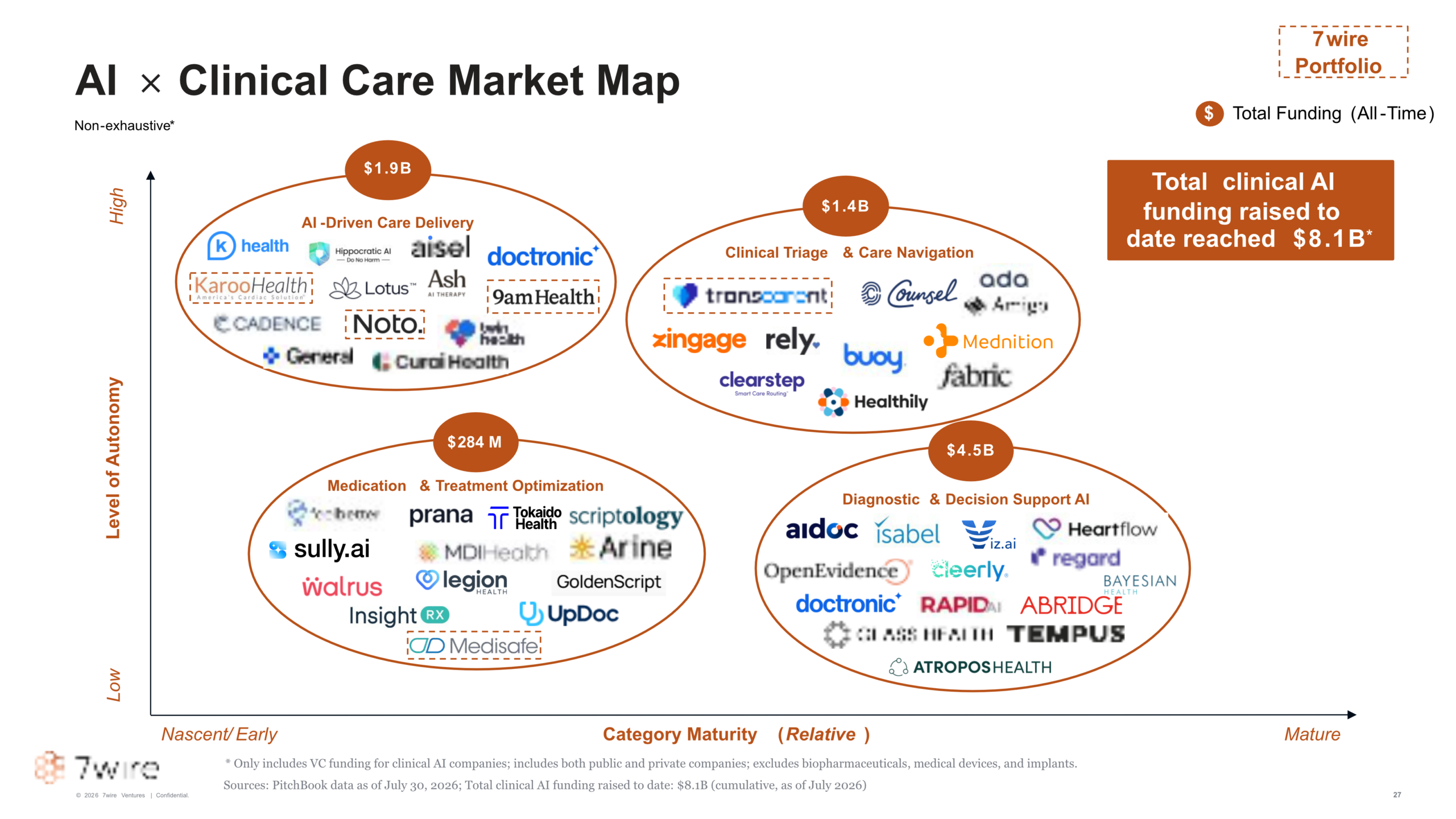
Clinical AI funding reached a record $1.3 billion in 2025, nearly three times the 2020 total, against cumulative category funding of roughly $8.1 billion. The more telling shift is check-size: average round size roughly tripled from about $30 million in 2020 to about $95 million in 2025, while deal volume peaked at sixteen in 2024 and then consolidated into fewer, larger bets — the pattern of a category moving from experimentation to conviction. We organize the market into four segments along the autonomy curve and clinical use case.
Diagnostic & Decision Support AI ($4.5B raised to date). Tools that support or perform diagnostic reasoning and point-of-care decisions, spanning imaging, pathology, and the synthesis of longitudinal, high-volume information. This is the most mature and best-capitalized segment, reflecting the FDA’s concentration of AI clearances in radiology and the relative ease of proving value against a defined imaging endpoint. Notable companies include:
- Heartflow: Publicly traded AI-powered coronary imaging platform that analyzes cardiac CT scans to assess blood flow and quantify arterial plaque, helping clinicians diagnose coronary artery disease and determine who needs intervention.
- Aidoc: FDA-cleared imaging decision support deployed across 1,600+ hospitals and 150+ U.S. health systems, flagging time-sensitive findings inside existing radiology workflows. In one prospective study, adjunctive AI raised radiologist sensitivity for incidental pulmonary embolism from 80% to 96% with no meaningful change in specificity or turnaround time.
- Glass Health: Clinical decision support platform that generates differential diagnoses and management plans. On a penalty-based safety rubric that scores potential for harm rather than raw accuracy, it outperformed board-certified physicians using conventional resources — a more meaningful benchmark than exam-style scores.
Clinical Triage & Care Navigation ($1.4B raised to date). AI that directs patients to the appropriate level of care, specialty, or setting through symptom checking, acuity scoring, and intake. This segment sits closest to the consumer and absorbs demand fastest, but it is also where the line between navigation and clinical advice is most consequential. Notable companies include:
- Transcarent (7wire portfolio): AI-powered clinical orchestration platform serving 20M+ members across 1,700+ self-insured employers and health plans. Its WayFinding platform continuously scans an employer’s population, identifies opportunities, and pairs AI agents with clinical teams to proactively coordinate care.
- Fabric: AI-driven care enablement system that guides patients to the right point of care through an assistant that collects symptoms, answers questions, and schedules appointments.
- Clearstep: Clinical-grade symptom checking and triage that routes patients to appropriate care settings and integrates with health system access and scheduling workflows.
AI-Driven Care Delivery ($1.9B raised to date). AI that delivers an element of care itself — prescribing, triaging, or managing a condition end to end — under a defined regulatory pathway or clinician oversight. This is the segment furthest up the autonomy curve, and the one where regulatory clarity will most directly set the pace of scaling. Notable companies include:
- 9am Health (7wire portfolio): AI-native virtual specialty platform managing high-cost cardiometabolic conditions with at-home labs, connected devices, and medication management. AI runs across lab extraction, ticket triage, progress notes, and proactive outreach, and a member-facing agent routes people to the right care team member.
- K Health: Virtual primary care platform that runs an AI-driven clinical intake to generate a working diagnosis and care plan, then connects patients to clinicians for treatment.
- Cadence: AI-enabled remote monitoring and chronic care platform pairing connected devices with a dedicated clinical team to manage hypertension, diabetes, and heart failure between visits.
Medication & Treatment Optimization ($300M raised to date). AI-assisted dosing, treatment plan adjustment, and medication safety and interaction screening. This is the least capitalized of the four segments and, in our view, the most underappreciated — medication decisions are high-frequency, rules-amenable, and tied directly to both clinical risk and pharmacy spend. Notable companies include:
- Arine: Medication intelligence platform that analyzes clinical, behavioral, and social data to flag medication-related risks and recommend interventions for health plans and risk-bearing providers.
- Walrus Health: AI-enabled medication management service that identifies employees on complex or high-cost regimens and pairs them with clinical pharmacists to improve adherence and reduce prescription spend.
- FeelBetter: Pharmaco-clinical intelligence platform that identifies the highest-risk polypharmacy patients and prioritizes pharmacist intervention where it will change outcomes.
Perspectives from Key Opinion Leaders
To ground these themes in operator, payer, and regulatory experience, we convened two panels. The first, on provider and consumer impact, brought together Dr. Dave Newman, Chief Medical Officer for Virtual Care at Sanford Health; Anton Kittelberger, Co-Founder and Co-CEO of 9am Health; and Anmol Madan, Founder and CEO of RadiantGraph (and author of Machines Will See You Now). The second, on the regulatory environment, convened Andrea Linna, a partner in Wilson Sonsini’s digital health and healthcare regulatory practice; Dr. Jesse Ehrenfeld, Global Chief Medical Officer at Aidoc and former President of the American Medical Association; and Nathan Hammer, VP of Strategy at UnitedHealth Group.
Both panels converged on similar preconditions for clinical AI: trust is earned at three separate levels, and failing any one of these stops a deployment cold. Clinically, a tool needs credible evidence, a defined intended use, and performance that holds in the population where it runs — which requires vendors to be candid about limitations. Operationally, it must reach the right person at the right moment and make a clinician’s shift easier. Institutionally, it requires continuous monitoring for drift and bias, escalation pathways, and clarity about who is accountable; regulatory clearance is a starting point, not a finish line, and plenty of pilots prove a model works and then fail to scale on exactly these grounds.
Also, much of the bottleneck turns out to be organizational and governance-related, rather than technical. When a clinician wants to introduce a new medication, the approval pathway is well established and everyone knows how to use it; when a clinician finds an AI tool they want to use, there is often no comparable process, and many do not realize institutional sign-off is required at all. Patients, meanwhile, arrive having already consulted a chatbot and want to know which tools their health system stands behind. Deciding which AI tools are approved, and keeping that list current, has become a core institutional responsibility — and the capacity to do it well, through review boards, monitoring infrastructure, and dedicated analytics teams, is the real constraint on adoption. Where that capacity already exists, the gains are concrete: one health system’s AI-enabled virtual nursing program cut falls with injury by more than half while reducing documentation time and nurse turnover, and when another operator placed an AI agent in front of every member, only about 6% opted out.
The harder constraints are economic and legal. Panelists were direct that health systems buy clinical AI on efficiency — minutes saved, backlogs cleared — rather than on safety or quality, and the analogy offered was ultrasound guidance for central line placement: clearly safer, but adoption took a decade because nothing paid for it, and it spread first in well-resourced academic centers. Unless payment rewards better care rather than the use of a tool, clinical AI risks widening access gaps rather than closing them. The regulatory patchwork was the barrier every panelist named, and the consensus was that the December 2025 executive order has so far changed little in practice — companies are still being advised to navigate each state’s law individually for the foreseeable future. Liability is equally unsettled: with a physician in the loop, malpractice remains the operative trigger, but product liability theories against developers are now being tested in court and proposed federal and state frameworks could shift that balance.
Two forward-looking conclusions stood out. Healthcare will need purpose-built platforms rather than frontier models or in-house builds, because plans and systems operating on low-single-digit margins cannot afford the engineering teams this requires. And as agents take on more of the preparatory work, the design objective is not maximum autonomy but concentrating clinical judgment where it changes outcomes, since approval without engagement carries its own risk. Finally, when asked where care lands in three to five years, the panelists agreed on the following: AI as a tool clinicians leverage rather than a replacement, genuinely deflationary economics, and the first instances of humans and machines sharing the simplest clinical tasks within 24 to 36 months.
7wire Ventures Predictions
- Consumer demand will force the pace, not providers, payers, or regulators. Consumers are already using AI to self-diagnose and seek second opinions ahead of any regulatory clarity, and younger, digitally native users will expect that capability to be covered. Self-directed demand will pull the industry forward faster than it is prepared to move, and the organizations that build a sanctioned, safe front door will capture it rather than cede it to general-purpose chatbots.
- As AI absorbs the transactional parts of medicine, it will strengthen rather than replace the clinician relationship. Physician value will shift decisively toward judgment, escalation, and trust — the parts of the encounter that do not compress. The build goal is not maximum automation but maximum concentration of clinical judgment where it changes outcomes.
- The “physician absorbs all risk” model will not hold. As AI enters diagnosis and treatment rather than documentation, liability will shift toward developers and tools, and malpractice insurers will need underwriting frameworks that do not exist today. The companies that win will have designed for this from the start: narrow, well-documented intended use; audit trails that can reconstruct why a recommendation was made; contracts that state plainly who carries the risk; and a deliberate sequence for which states to enter first.
- Agentic AI will make continuous population management operationally real. Unlike the episodic model that dominates today, agents can monitor and act on populations continuously — delivering the “always-on” management value-based contracts have always required but staffing models could never support. This is where the reimbursement infrastructure now being built becomes genuinely load-bearing.
Clinical AI is a different category than administrative AI with different buyers, different evidence requirements, and a different risk profile — and the companies that win it will not be the ones with the best benchmark scores. They will be the ones that lead with real-world outcomes, arrive inside the workflow at the moment of decision, climb the autonomy curve one bounded task at a time, and treat payment and state regulation as design inputs rather than afterthoughts. At 7wire Ventures, we believe the next generation of clinical AI companies will be defined by what they can prove in a patient encounter, get paid for, and answer for.